Mid-Decade Redistricting Keeps Maryland Busy
Maryland is currently facing redistricting questions at both the statewide and local levels. During the 2026 legislative session, lawmakers considered changes to Maryland’s congressional districts outside of the normal post‑census cycle. At the same time, litigation has challenged the legality of Prince George’s County’s council district map. SCRIM monitors both developments as part of its commitment to structural reform, transparency, and constitutional compliance in the redistricting process.
New Congressional Districts?
During the 2026 legislative session, members of the Maryland General Assembly advanced legislation to redraw the state’s eight congressional districts mid‑decade. The proposal moved through the House of Delegates but stalled in the Senate, where it has not advanced further. As a result, Maryland’s existing congressional map remains in place.
Although the bill has not been enacted, the episode raises important institutional questions. Mid‑cycle redistricting is unusual. Redrawing congressional boundaries outside the regular census cycle can blur the lines between legitimate policy revision and reactive political maneuvering. When maps are reconsidered in response to developments in other states or short‑term partisan dynamics, public confidence in the stability and neutrality of the process can erode.
Why This Raises Structural Questions
Maryland’s redistricting framework already vests significant authority in the legislative branch. Any mid‑decade effort to revise congressional districts should be subject to heightened transparency, robust public input, and clear standards. Guardrails matter. Without them, redistricting risks becoming a recurring political tool rather than a once‑per‑decade exercise grounded in population equality, community integrity, and Voting Rights Act compliance.
SCRIM’s Approach
SCRIM evaluates redistricting proposals based on process integrity and constitutional principle. It does not take positions based on partisan outcome. Any proposal to alter congressional districts should be transparent, independently informed, consistent with equal population requirements, and fully compliant with federal voting rights protections.

Unequal and Unfair Council Districts in Prince George’s?
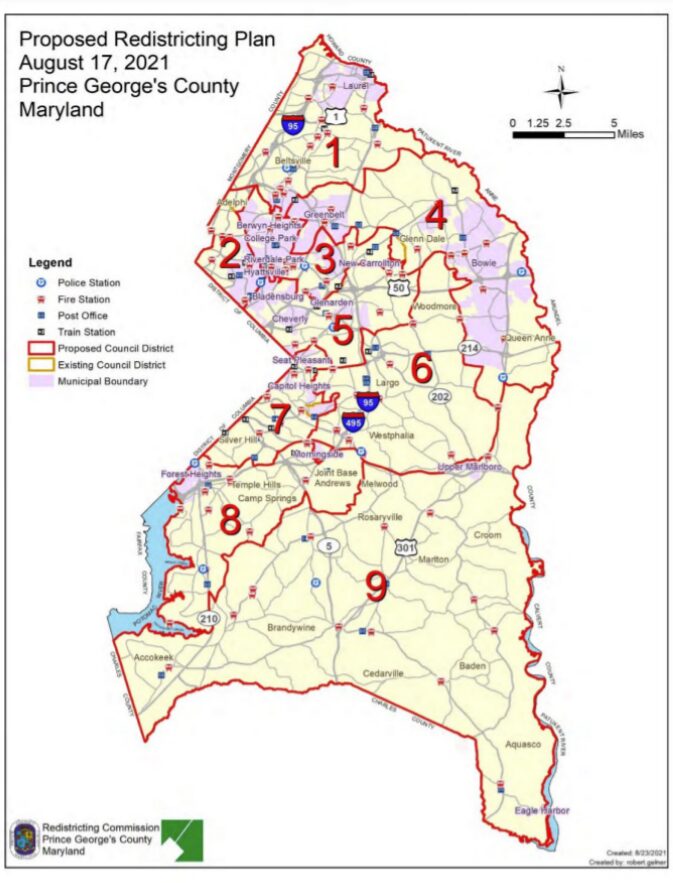
Prince George’s County adopted its current council district map following the 2020 census. In 2025, residents filed a federal lawsuit challenging that map. The complaint alleged that the adopted districts failed to meet constitutional and local requirements, particularly with respect to population equality and compactness.
The federal district court ultimately upheld the county’s redistricting plan. While the existing map remains in effect, the litigation highlighted recurring structural concerns in local redistricting processes.
Issues Raised in the Litigation
The case focused on whether district populations were sufficiently equal to satisfy “one person, one vote” standards, whether district shapes met expectations of compactness, and whether certain communities were divided in ways that undermined coherent representation. Even where courts decline to overturn a map, these issues remain central to ongoing debates about how redistricting should be conducted.
Proposed Charter Amendment
SCRIM and community partners have now submitted a proposed amendment to Section 305 of the Prince George’s County Charter to strengthen the redistricting process.
The proposal would strengthen the independence of the Redistricting Commission, clarify the criteria governing how council districts are drawn, and prevent political overrides of commission-adopted maps.
Learn more about the Prince George’s County reform effort